Retirement Savings Plan
This is an effective method to reduce your tax burden.
To minimize dependence on pay-as-you-go pension systems, the government encourages citizens to take a more active role in retirement planning. This incentivizes them to invest in funded pension systems, similar to those in place in the United States.
To encourage this initiative, the government offers a tax deduction proportional to your marginal tax rate (MTR) on the invested amount.
To determine your MTR, refer to the previous article. Then, use the following formula to estimate the amount you could deduct if you invest a certain sum:
- INVESTED_AMOUNT * 0.MTR % = Tax Deduction Amount
Let’s take an example:
- Suppose I invest €3000.
- And my MTR is 30%.
- In this case, 30% of €3000 equals €900. This means I can deduct €900 from my taxes payable for the current fiscal year.
In summary, the higher your MTR, the more beneficial the tax deduction is for you.
However, it’s important to note some limitations of this scheme. The invested amounts cannot be withdrawn before retirement, except under certain conditions:
- Disability (you, your children, your spouse, or your civil partner)
- Death of your spouse or civil partner
- Expiration of unemployment benefits
- Over-indebtedness (in this case, the over-indebtedness commission must make the request)
- Cessation of self-employed activity following a liquidation judgment
- Acquisition of primary residence (except for rights from mandatory contributions).
There is also a limit to how much you can deduct from your taxes. You can find this information on your tax notice under the category “RETIREMENT SAVINGS CEILING”.
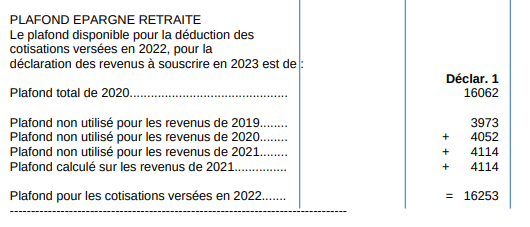
Please note that the ceiling can be accumulated over several years, up to a maximum of four. If you don’t fully use these ceilings from one year to the next, they are not lost.
For each year, the PER contribution deduction ceiling is calculated in two ways, giving two different ceilings, and we’ll take the most advantageous one:
- 10% of the previous year’s PASS (the annual Social Security ceiling. It reaches €46,368 in 2024), which equals €4,636.
- or 10% of your income within the limit of 8 times 10% of the previous year’s PASS (limit = €37,094 for 2024 - 4,636 x 8 = €37,094). To reach the limit, you would need to earn approximately ~€350,000 in annual income.
The tax administration uses these ceilings in a well-defined order: it starts by deducting the current year, then moves to the oldest year.
If you have accumulated several years of unused ceilings, be sure to deduct amounts from the current year and the oldest year. This allows you to optimize your deductions and not lose unused ceilings.
Finally, keep in mind that when withdrawing funds at retirement, you will be taxed. However, it’s likely that your marginal tax rate (MTR) will be lower than when you were working. This makes the system advantageous despite taxation at withdrawal.
Apart from having to pay taxes eventually, this essentially amounts to getting an interest-free loan from the government, which remains a notable advantage.