Investing Today: A Guide to Taking Control of Your Personal Finances
Taking an interest in investing is already a significant first step, opening the door to a series of questions often motivated by fear of the unknown, and especially, the fear of losing money.
However, as we gain knowledge, this fear tends to fade away, as we begin to understand how financial markets work.
There’s a famous quote, frequently cited to encourage people to take the plunge:
“The best time to invest was yesterday. The second best time is today.”
This phrase emphasizes an essential truth: regardless of the timing, it’s always better to start investing as early as possible in life.
It’s also crucial to dispel misconceptions, such as the belief that significant financial means are necessary to get started.
The key is to start as early as possible, investing money that you’re willing to allocate for this purpose, in accordance with your means and personal goals.
The best way to save money is to make transfers at the beginning of the month to your savings or investment accounts, keeping only what you need to live on in your current account during the month.
Indeed, the bank invests your money that sits in your current account and therefore makes money at your expense. This is why you’ll never find a bank advisor who will advise you to transfer this money to a Livret A or any other investment vehicle that would no longer earn them money.
The bank invests this money at the €STR rate, which is the short-term rate in the eurozone, except that the interest doesn’t go to you but directly to the bank.
Furthermore, keeping all your money in your current account creates an undesirable psychological effect: it makes you think you’re rich and that you can spend without worrying about anything. Overall, this doesn’t help you actually save money.
Strategies
As in many areas of life, discipline and consistency can lead to great achievements. This also applies to personal finance.
Set your goals and establish a strategy to reach them, then let the magic happen.
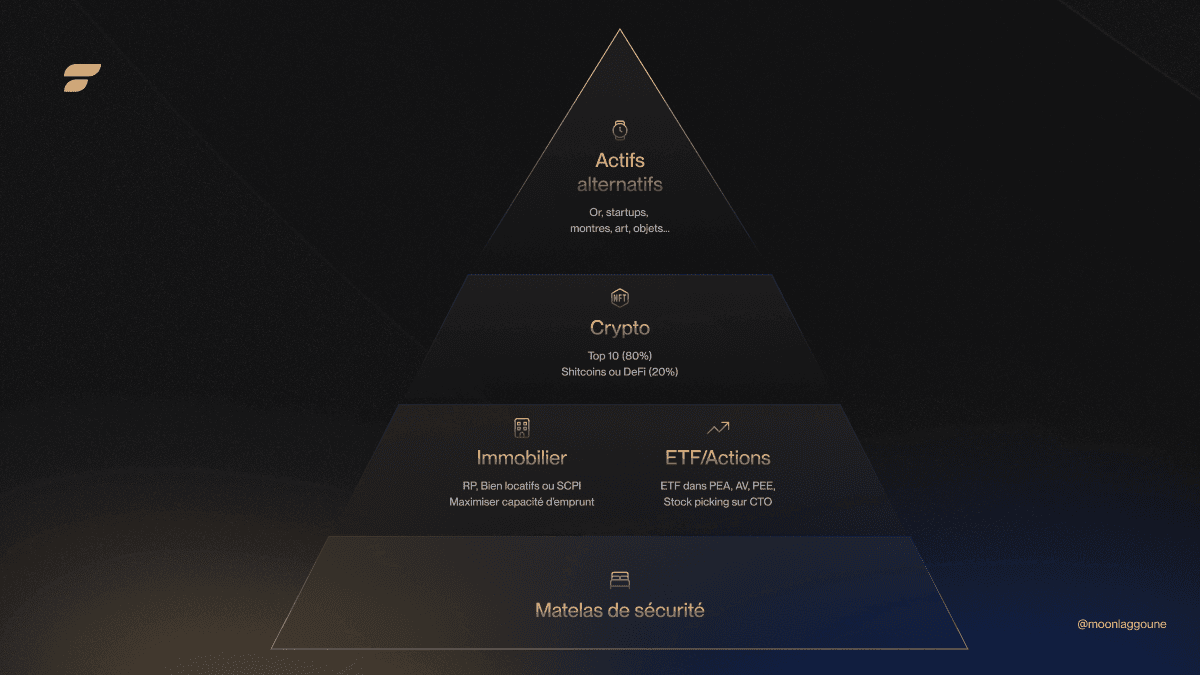
The famous Maslow pyramid helps beginners quickly understand the stakes and adopt an effective strategy to get started well.
Taking Action
It’s time to take control of your assets. Here’s a “starter kit” to begin well:
Choose an Online Bank with Low Fees
Choose an online bank such as Boursorama (BoursoBank) or Fortuneo, etc…
These banks, entirely online, offer highly competitive services compared to traditional banks like Société Générale or Crédit Agricole thanks to this system.
They offer many free services, such as instant transfers, currency conversion fees, or free debit cards.
Safety Net
Build up a reserve of 3 to 6 months of expenses, commonly called a safety net, ideally placed in savings accounts such as the Livret A, LDDS, or LEP, which are guaranteed and very secure savings solutions.
This way, you can make instant transfers in case of urgent need for liquidity to cover unexpected expenses.
These accounts offer low returns and often don’t cover inflation, except for the LEP (which offers a 6% return, accessible only based on income). However, they are ideal for placing your safety net as they offer high liquidity.
It’s preferable to open these accounts with your online bank for easier management.
Stock Market
Open a life insurance (Linxea) and a Stock Savings Plan (PEA - Bourse Direct) with low fees.
These are two investment tax wrappers that offer tax advantages after a certain holding period (8 years for life insurance and 5 years for PEA).
It’s recommended to set up automatic monthly transfers for the amount you wish and can invest.
This passive and disciplined method allows you not to have to think about it constantly.
This money will ideally be invested in the stock market in financial products such as stocks, euro funds, or ETFs.
Bank Leverage
Determine your borrowing capacity either through online tools or with the help of a banker or broker, with a view to acquiring your primary residence or a rental property.
To decide on buying your primary residence, several criteria must be taken into account, such as how long you plan to stay in this residence and the level of the local real estate market.
Keep in mind that the higher the price per square meter, the less advantageous buying a primary residence becomes.
Alternative Investments like Cryptocurrencies or Private Equity
Additionally, if you’re open to risk, you can consider investing in cryptocurrencies or startups (private equity).
Conclusion
In conclusion, personal finance management isn’t a matter of luck, but of judicious choices and well-thought-out strategies.
Finally, perseverance and discipline in applying your investment strategy are essential to achieve financial security and economic freedom.
Every small step counts, and your wealth is the sum of these steps. So, take these tips as a starting point and begin today to build your financial future.