Unqualified RSU Plan
This article aims to explain as clearly as possible how RSUs work in an unqualified plan in France.
RSUs are not well known in France, and for good reason - very few companies offer free shares to their employees. The company needs to be publicly traded and willing to give shares to its employees for free.
However, RSUs are becoming increasingly popular thanks to American companies recruiting employees worldwide, especially due to the power of remote work.
Thus, we face a new complexity that we’re not used to - understanding how these shares will be interpreted by the French tax authorities.
That’s why I looked into this topic to understand the subtleties surrounding these RSUs and also to share this knowledge with as many people as possible so everyone can benefit.
Indeed, after trying to research everywhere, there are hardly any resources to rely on. While the simplest solution would be to hire a tax lawyer to handle everything for us, that’s not the goal here. The idea of this article is to make this knowledge accessible to everyone so they can master their RSU plan from A to Z by themselves.
Let’s begin…
The Steps
An RSU plan consists of several steps…
Indeed, in most cases, the life of an RSU plan spans several years, because the primary objective of an RSU plan is to retain employees by letting them benefit from company shares and thus from the company’s performance.
RSUs are somewhat of a carrot for employees to keep them in the company as long as possible.
This is why in most cases, an RSU plan is spread over 4 years.
Here are the main steps:
Determine the number of shares you will receive
During your hiring, your contact person, typically HR, will tell you the amount they will give you in dollars.
Indeed, companies will always talk in dollars regarding the quantity you will be given in shares. Then, from this dollar amount, they will determine how many shares you will receive. But what really matters is the number of shares you will be given, because the share value fluctuates afterward and can result in a considerable sum.
Once in the company, to determine how many shares you will receive, the company will take the average closing value of the share for the month of your arrival.
Thus, it’s better for you if the share price is as low as possible to benefit from as many shares as possible within the dollar amount allocated to you. However, you can’t do anything to get a lower share value; you need to be lucky here with good timing.
Once the first month has passed, they take the average closing value and calculate how many share units are needed to reach the dollar amount you were given at hiring.
Now you know the total potential number of shares you could have!
After learning this, your company will open an account for you with a broker they have a contract with, most often E*Trade, but this can vary from one company to another.
Your future shares will be with this broker.
The Vesting
However, as mentioned above, the RSU plan is here to retain you!
Indeed, to see these shares in your pocket, you’ll need to vest them, and to vest them, you’ll need to stay with the company.
Vesting schedules can vary from one company to another, but generally, the plan is as follows:
- Plan based on 4 years
- 1st year: At the end of your first year with the company, you’ll vest 25% of your total shares.
- 2nd year: You’ll vest 25% of 25% every 3 months.
- 3rd year: You’ll vest 25% of 25% every 3 months.
- 4th year: You’ll vest 25% of 25% every 3 months.
The first year is the longest to wait because you can’t get your first shares until after spending a full year in the company, but for the following years, the vesting pace accelerates since you’ll vest 25% of the global 25% of shares every 3 months.
Note again that vesting schedules can vary between companies.
The Acquisition
The long-awaited event occurs, the vesting day of your first 25% of shares from year 1.
A new series of steps will occur.
In English, this is called “vesting,” meaning the moment when these promised shares become your full possession.
At the time of vesting, a series of steps will occur:
- The broker will “vest” these shares for you, in other words, grant them to you.
- But they will also perform a mechanism called “Sell-To-Cover”. We’ll come back to this mechanism later.
- Once this mechanism is complete, the shares will be fully yours.
These steps usually happen over 3 days:
- Day 1: nothing happens
- Day 2: the sell-to-cover is applied
- Day 3: your shares are fully yours, you can sell them if you wish.
The Payslip
There is a fundamental concept to understand about how RSUs are interpreted in France.
Unqualified RSUs are treated as salary at the time of vesting.
Thus, during vesting events, the amount you will vest is directly considered as salary.
This is where it becomes problematic compared to qualified plans that benefit from a tax allowance.
Consequently, the amount you will vest and that will end up in your pocket can quickly decrease.
A series of deductions will follow, here they are:
Sell to cover
During vesting, the first event to occur is the “Sell-to-cover”, this event will allow the company to sell some of your vested shares to pay taxes.
These taxes are:
- The bank operator’s margin, in this case the broker like ETrade who will take a portion to pay for order fees (buying/selling) but also custody fees.
- US withholding tax, like in France, you will pay taxes to the US for these shares.
It’s quite crazy, having to pay what amounts to double taxation:
- one in the United States
- one in France.
However, some RSU plans in certain companies allow bypassing this double taxation by reimbursing part of the amount that was sold.
If this is the case, in your payslip, you will find a line like this:
- “Restricted stock unit refund taxes withheld” which will indicate the amount that was reimbursed to you.
This amount will appear directly in the gross amount of your payslip, it will be added to your monthly gross total, and thus will further increase your income.
Note that generally, the reimbursed amount doesn’t exactly match the amount that was sold by your broker because the broker will always take their cut, which can be more or less significant.
Social contributions
Again, since everything is considered as salary at vesting, the amount appears as gross on your payslip, and gross means social contributions apply.
Indeed, social deductions will apply to the total RSU amount you have vested, which means a sum will go to the State.
Taxes
Finally, after social contributions, come taxes!
Your total RSU amount that you will vest will again be cut by another factor, which is taxation.
If it’s your first year in the company, be careful to adjust your withholding tax rate properly, as you could end up with a large adjustment the following year.
Indeed, since everything is treated as salary, we cannot benefit from the flat tax which is often more advantageous when dealing with large sums, especially if the stock has performed well during the period when you vest the RSUs.
Thus, it’s always preferable during vesting that the share price is as low as possible to avoid paying too many contributions linked to our marginal tax rate. Because it’s more advantageous to later pay the flat tax (30%) when selling individual shares, but again, luck plays a role here and we can’t do anything about it…
Summary
It’s finally over! But unfortunately, the remaining amount bears little resemblance to the amount we originally vested.
However, there is good news: during vesting, given that we pay a set of taxes on the total amount that was vested at time T, the capital gains have been reset relative to when you vested the shares.
Thus, in theory, if the stock doesn’t perform excessively, you will pay very little flat tax when you sell your shares later, because the relative moment is the share price at vesting.
Moreover, ETrade categorizes the sets of shares that were vested by date. You won’t end up with all shares mixed in a single basket but rather they will be grouped by vesting date, and this is good news because it means it will be easier to track capital gains but especially to create a kind of share selling strategy to optimize taxes on exit.
Indeed, it will probably be more judicious to prioritize selling shares that are closest to the share value at the time you want to sell them to avoid paying too much flat tax.
There is also another aspect to know about and which can be scary when you think about it for unqualified plans. It’s the fact of paying taxes on the entire amount we vested and not just on what was sold.
This means that if tomorrow the stock loses value and we still haven’t sold the shares for which we were taxed, we will pay more in deductions than the value we have since we paid deductions when the stock was worth $150 but we sold it lower due to the drop to $120.
This would mean that we paid taxes for something we didn’t directly have, because at the time we hadn’t sold the shares right after vesting.
Example
To make the above explanation even clearer, we will take a concrete example of an employee who joins a company that offers RSUs (free shares) as a bonus.
The employee was hired by a company offering an RSU plan in the form of free shares.
They grant you $100K in shares that will vest over 4 years. That’s 25% per year. To determine how many shares you will inherit, they take the average closing value of the share for the first month of your arrival. Let’s say the average value is $100 per share. Thus, if we look at how many times $100 goes into $100K (100,000 / 100 = 1000), we therefore have 1000 shares.
Thus, if the employee stays the full 4 years with the company, they will have vested a total of 1000 shares that will have either gained value over the years or lost value.
It is often said that stock concentration greatly helps increase wealth, unlike diversification which rather helps maintain wealth. Here, thanks to these RSUs, it’s an opportunity to benefit from concentration.
In short, you understand, the RSU plan is still a blessing, because if the company performs well, you can quickly end up with a nice nest egg in shares.
Time passes… after one year in the company, you finally vest 25% of these 1000 shares, they truly become yours. Except that now 1 share is no longer worth $100, but $150, so the original $100K is now worth $150K, because 1000 shares x $150 = $150K.
Again, since this is an unqualified plan, everything is treated as income.
Indeed, the amount you vested in the first year, or 25% of $150K = $37,500, is treated as income.
The steps we saw will take place, thus:
- The “sell to cover” will take effect and take a portion of your vesting shares to pay taxes on the US side (broker/US taxes).
- If your company offers it, a major part of this “sell to cover” will be reimbursed to you on the payslip for the month when you vested these shares.
- On your payslip, you will therefore have your gross income inflated because the vested amount, the 25% of shares are treated as salary.
- You pay social contributions and taxes.
- Finally, the shares that weren’t sold by the “sell to cover” end up in your ETrade account and you can do what you want with them, meaning sell them when you want. We can remind that you have already paid taxes on these shares, so you will only have to pay any capital gains if there are any.
Regarding tax declaration, given that the global amount is treated as income, it’s simpler to declare your taxes, because normally everything is already pre-filled.
Thus, if box 1AJ is properly auto-filled with the same amount found at the end of your December payslip in the “Net taxable” section, then everything is good. You can also verify the amount in the “Withholding tax” category because in the end, since everything is treated as salary, the taxes you paid will be found in this category.
However, it becomes more complicated for declaration when it comes to declaring capital gains when you sell your shares of your own accord.
But ETrade is a great help here, if you go to the “Gains & Losses” page, you can filter your stock sales by year.
Then, if you click on the question mark, you can find important information.
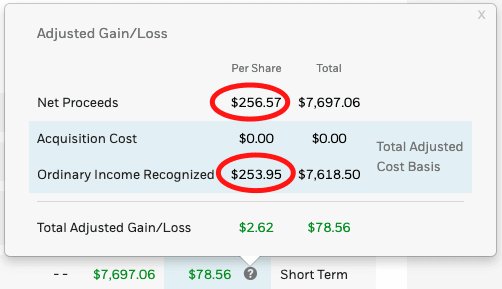
We can see that the “Ordinary Income Recognized” part corresponds to the share price when the vesting/sell-to-cover occurred for the portion of shares that was vested.
If you sell these shares, the relative point for calculating capital gains will be this amount, in this case $253.95 per share in the example.
Once you have this amount, you can calculate the capital gains or losses with your share selling price. Here, in the example, there is about $78 in capital gains to declare. Then 30% of these $78 will be taken by taxes (flat-tax).
Note that for tax declaration, you also need to convert to euros using the rate on the day of the share sale. You apparently need to take the Bank of France rate for that day.
Conclusion
I hope this article can help you in your global understanding of the subject.
I find it really important to understand the mechanism well because in my opinion, it would be too foolish to miss out on something as attractive as RSUs, we can say it, it could change your life if used intelligently.
Don’t hesitate to give me feedback of any kind on the feedback page, especially if you find errors in my statements.
The article aims to evolve as cases appear, always with the goal of understanding this mechanism.